
When AI describes your brand, is the answer accurate?
Customers, journalists and partners get their first impression from an AI answer shaped by sources you may not know exist. Eidoscore shows how assistants describe your business, catches false claims early in public communities, and turns outdated citations into a fix list.
AI brand monitoring shows how AI assistants such as ChatGPT, Claude, Gemini and Mistral describe your business, whether the answer is accurate and current, and which sources it relies on. Eidoscore adds the public conversations behind those answers, flags outdated or misleading claims early, and recommends fixes that your team approves before anything is published.
The first description is no longer yours.
The first description of your business a buyer reads is assembled by an assistant from reviews, forum threads and old coverage. Where the purchase is considered, a supplier, a clinic, a financial product, one confidently stated inaccuracy removes you from the shortlist without a conversation.
Checkable falsehoods about safety, pricing, ownership or a recall travel through communities faster than through press, and assistants pick up what circulates. By the time a customer asks whether it is true, it has been in the answer for days.
A false product claim circulates over a weekend, gets absorbed into the assistants' answer by midweek, and you find out from a customer asking whether it is true.
What changed overnight, and the evidence to judge it.
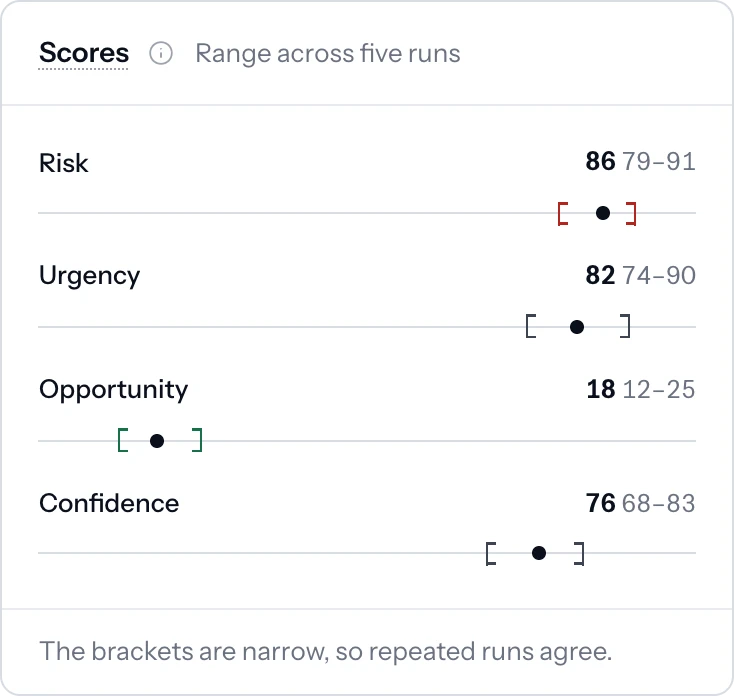
Two screens from the workspace, with the evidence one click away. Every figure is a range across scheduled runs, and every narrative links to the posts and answers behind it.
Start the day knowing what changed and what to do about it.
The command centre opens with a briefing: what happened, why it matters and what to do, with the changes since yesterday. A claim that grew over the weekend and that two engines now repeat is at the top, with a drafted response waiting for your approval rather than a chart to interpret.
- What happened, why it matters, what to do, in plain language
- Whether any engine has started repeating the claim, and in how many runs
- Drafts held for a named approver, never sent on their own
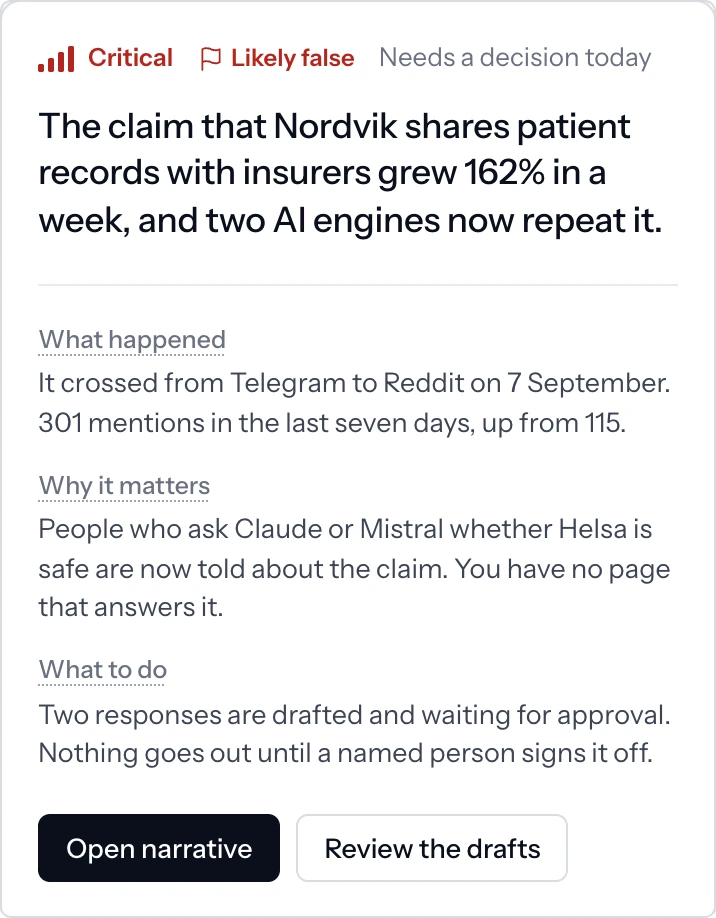
Judge a flagged claim with the evidence in front of you.
Each flagged narrative carries four scores: Risk, Urgency, Opportunity and Confidence, each shown as a range across runs rather than a single number. A flag is an early warning for your reviewer, not a verdict. The original posts and their translations sit one click away, and you approve or dismiss with the decision on the record.
- Risk, Urgency, Opportunity and Confidence, each as a range
- The original post and its translation behind every score
- Approve or dismiss, with the decision written to an audit log that cannot be edited
AI brand monitoring and narrative tracking.
The topics, sources and question sets we set up for teams like yours.
Brand description
How assistants summarise your products, leadership and history, measured over scheduled runs with ranges rather than a single score.
Claim tracking
Specific, checkable assertions about your business circulating in public communities, clustered and scored for spread and harm.
Competitive positioning
Whether assistants recommend you, omit you, or lead with a competitor when asked the questions your buyers actually ask.
Citation repair
Which sources shape the answer about you, which are outdated or weak, and a prioritised list of what to fix first.
Three jobs it does for reputation-sensitive brands.
Each one ends in something a named person can review, approve and send.
- 01
Track how assistants describe your products, your leadership and your record, with ranges and evidence
- 02
Early warning when false claims or hostile framing start moving in public communities
- 03
Citation gaps: which sources AI relies on about you, which are outdated, and what to fix first
Questions we hear from reputation-sensitive brands.
Something else?
The full list covers sources, method, security and commercial terms.
Listening tools count mentions. Eidoscore reads context, clusters mentions into narratives, and joins them to what AI assistants answer about you.
No. Eidoscore drafts, recommends and routes. A named person on your side approves anything before it goes anywhere, and every decision is written to an audit log that cannot be edited or deleted.
Public sources and EU hosting by default. Regulated-sector requirements are reviewed at onboarding.
What the brief contains.
A weekly brief every Monday at 06:00 and a monthly brief, both fixed once generated and exported as PDF or DOCX.
- An executive read: what happened, in plain language
- AI perception as a median with its range across scheduled runs
- Open citation gaps, each with its recommended action
Flags are reviewed by an Eidoscore analyst before the brief is generated. Approval stays with you.
Reports in the product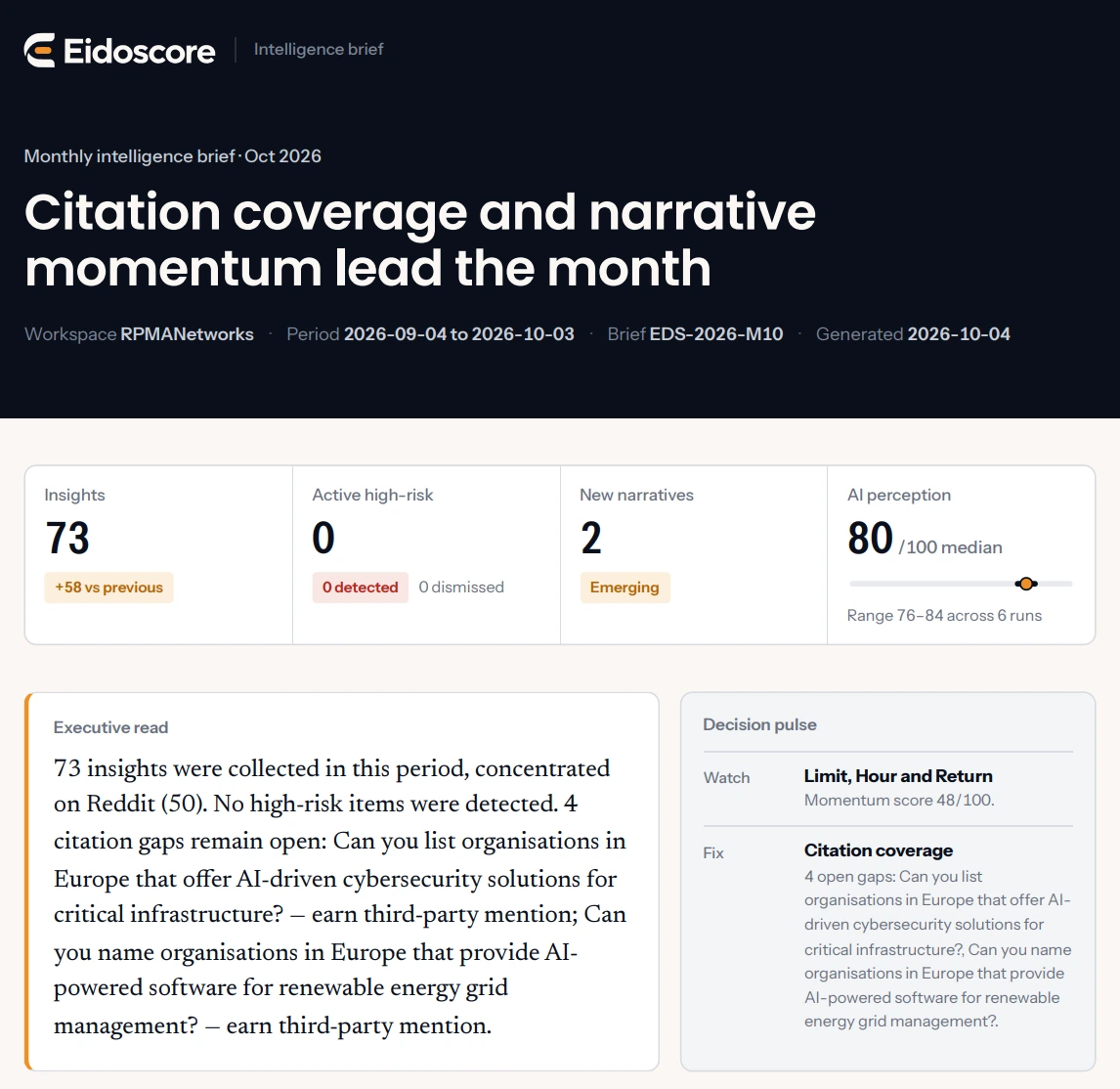
EU-hosted, public sources only
Public Telegram channels and Reddit communities. Never private groups.
Topics and narratives, not individuals
Flags are early warnings held for a reviewer, never automated accusations.
A named person approves every action
Nothing is published or sent on its own, and the audit log cannot be edited.
See this on your own narratives.
A working session on your questions and channels, with real answers and sources. Nothing is sent without your approval.