
Whose framing does AI give your cause?
Donors, journalists and policymakers now get their first answer from an assistant. Eidoscore shows how your cause and your organisation are described, which sources the assistants trust, and where the community conversation is moving, with an analyst reviewing every flag.
Four sentences decide the meeting.
Someone types your organisation's name, reads four sentences, and forms a view before reaching your site. Those sentences come from whatever is best indexed, which is rarely your latest work. Resolved disputes and superseded reporting carry weight because they generated coverage at the time.
Advocacy issues attract sustained, organised opposition, and the framing contest is usually settled in public forums long before mainstream coverage. A small comms team cannot read every channel, so it finds out when a journalist does.
A funder does their own research, gets a stale controversy in the second sentence, and quietly moves on. You never hear about the meeting that did not happen.
The conversation on one map, and the sources behind it.
Two screens from the workspace, with the evidence one click away. Every figure is a range across scheduled runs, and every narrative links to the posts and answers behind it.
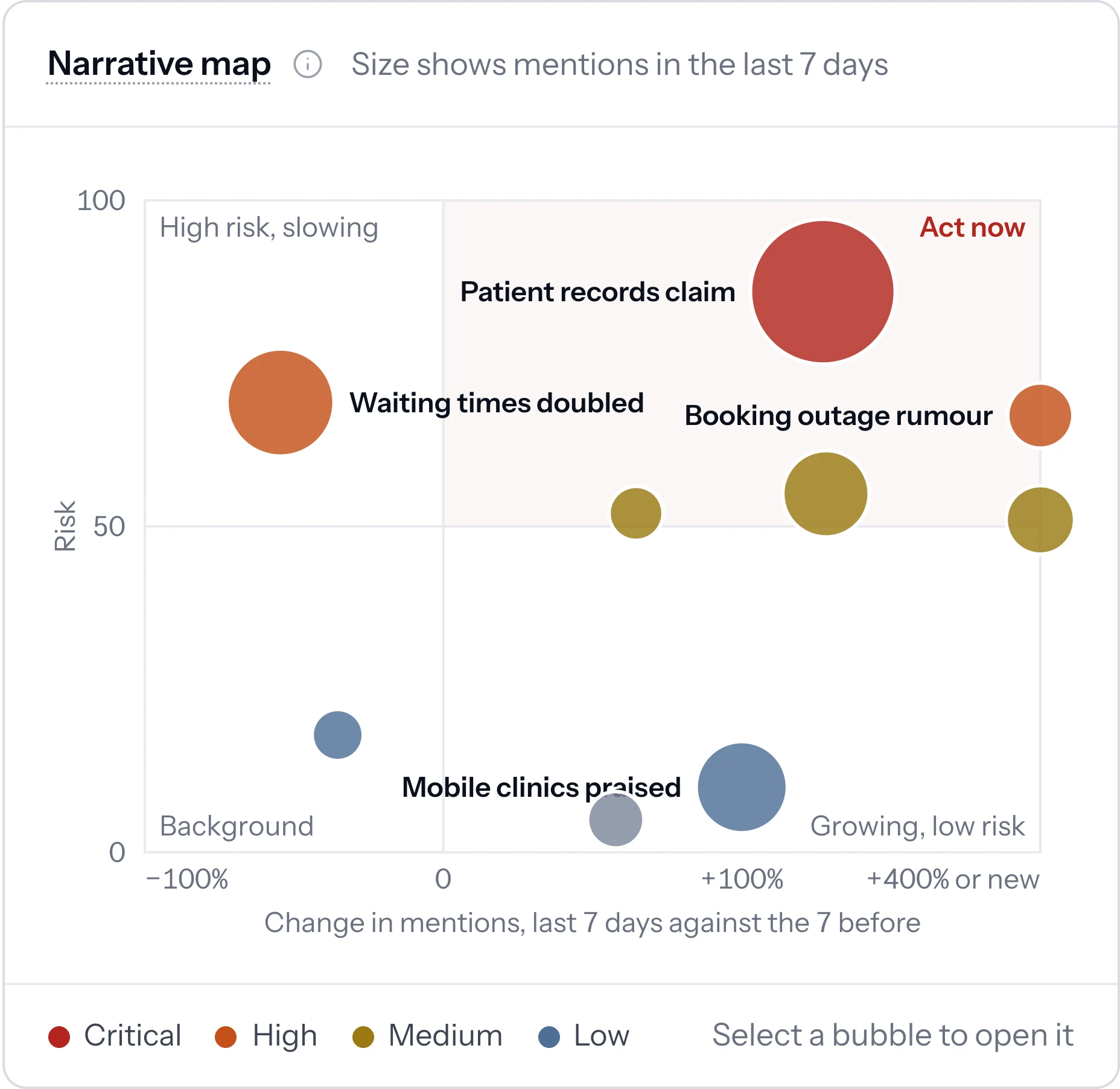
See the whole conversation at once, openings as well as risks.
The command centre plots every active narrative by risk against its change in mentions. Hostile framings sit in one corner and supportive communities in another, so you can see where a correction is needed and where an ally is forming without reading every thread.
- Each narrative placed by risk and momentum
- Stance on every item: hostile, questioning, neutral or supportive
- Click through to the posts behind any point, in the original language with a translation
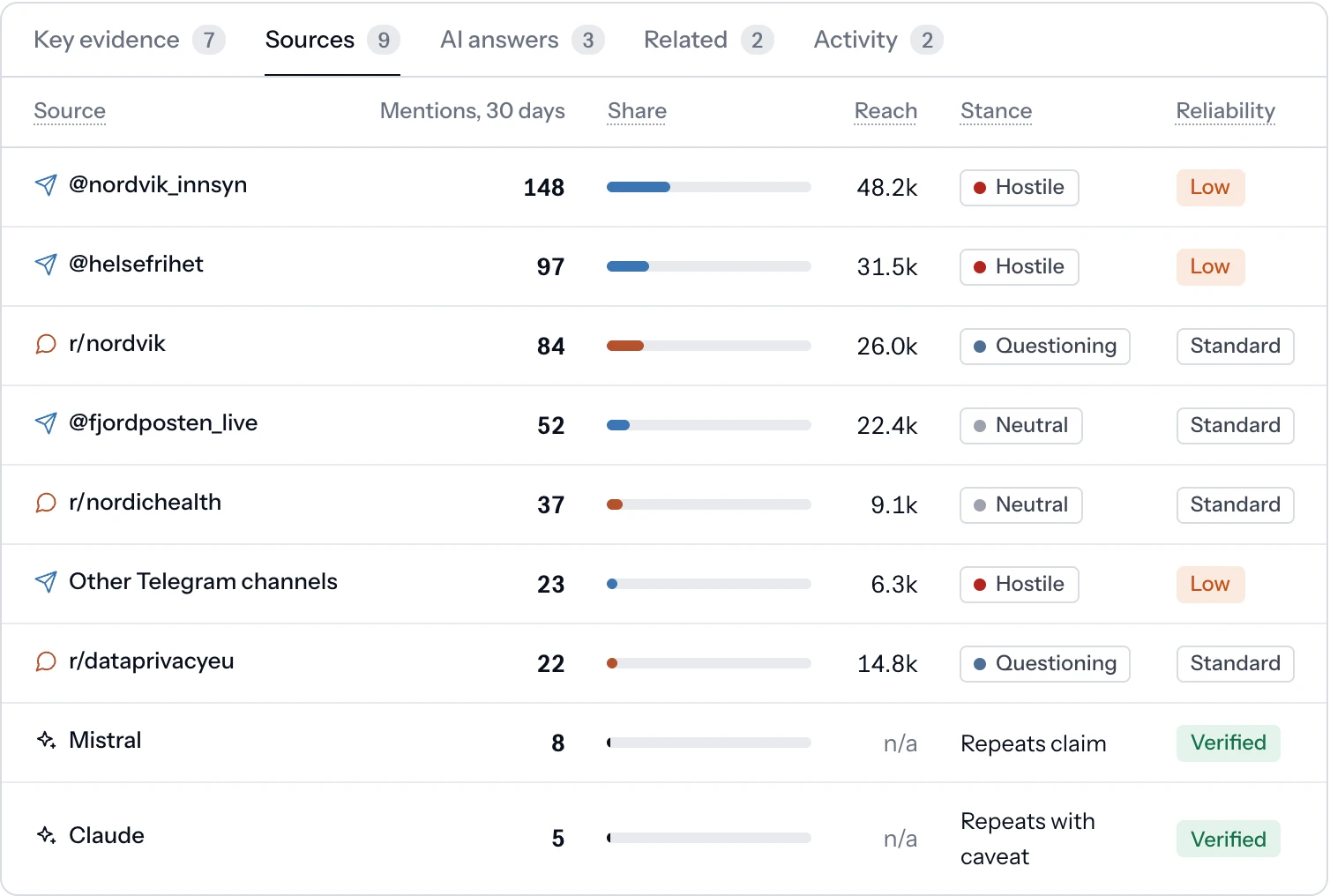
Find which channels and engines carry a framing.
Behind each narrative is a source table: every Telegram channel, Reddit community and AI engine that carried it, with mentions, share, reach, stance and reliability. It tells you whether a claim is confined to one channel or has reached an engine's answer, and where a correction would do most good.
- Channels and communities ranked by mentions, share and reach
- Whether any engine now repeats the claim, with or without a caveat
- Reliability on every source, so you know what to take seriously
What we monitor for you.
The topics, sources and question sets we set up for teams like yours.
Cause framing
How your issue is characterised across assistants and public communities, supportive, sceptical or hostile, with the language that carries each framing.
Organisational description
What assistants say about your governance, funding and record, and which sources that description is drawn from.
Misinformation signals
Claims about your cause that show early spread, flagged with evidence and held for a reviewer on your side.
Citation opportunities
Where your published research and reporting could be cited but is not, turned into a prioritised outreach list.
Three jobs it does for NGOs and advocacy.
Each one ends in something a named person can review, approve and send.
- 01
Monitor narrative framing around your issues across assistants and public communities
- 02
Detect misinformation about your cause early, with evidence attached
- 03
Turn citation gaps into a concrete content and outreach plan
Questions we hear from NGOs and advocacy.
Something else?
The full list covers sources, method, security and commercial terms.
No. The core deliverable is one reviewed brief a week, ten minutes to read. The workspace is there when you want the evidence behind it.
Every item is kept in its original language with a translation alongside. Priority languages and channels are confirmed during onboarding.
Early-warning flags with human review and evidence attached. We do not claim coordinated-campaign attribution.
What the brief contains.
A weekly brief every Monday at 06:00 and a monthly brief, both fixed once generated and exported as PDF or DOCX.
- An executive read: what happened, in plain language
- AI perception as a median with its range across scheduled runs
- Open citation gaps, each with its recommended action
Flags are reviewed by an Eidoscore analyst before the brief is generated. Approval stays with you.
Reports in the product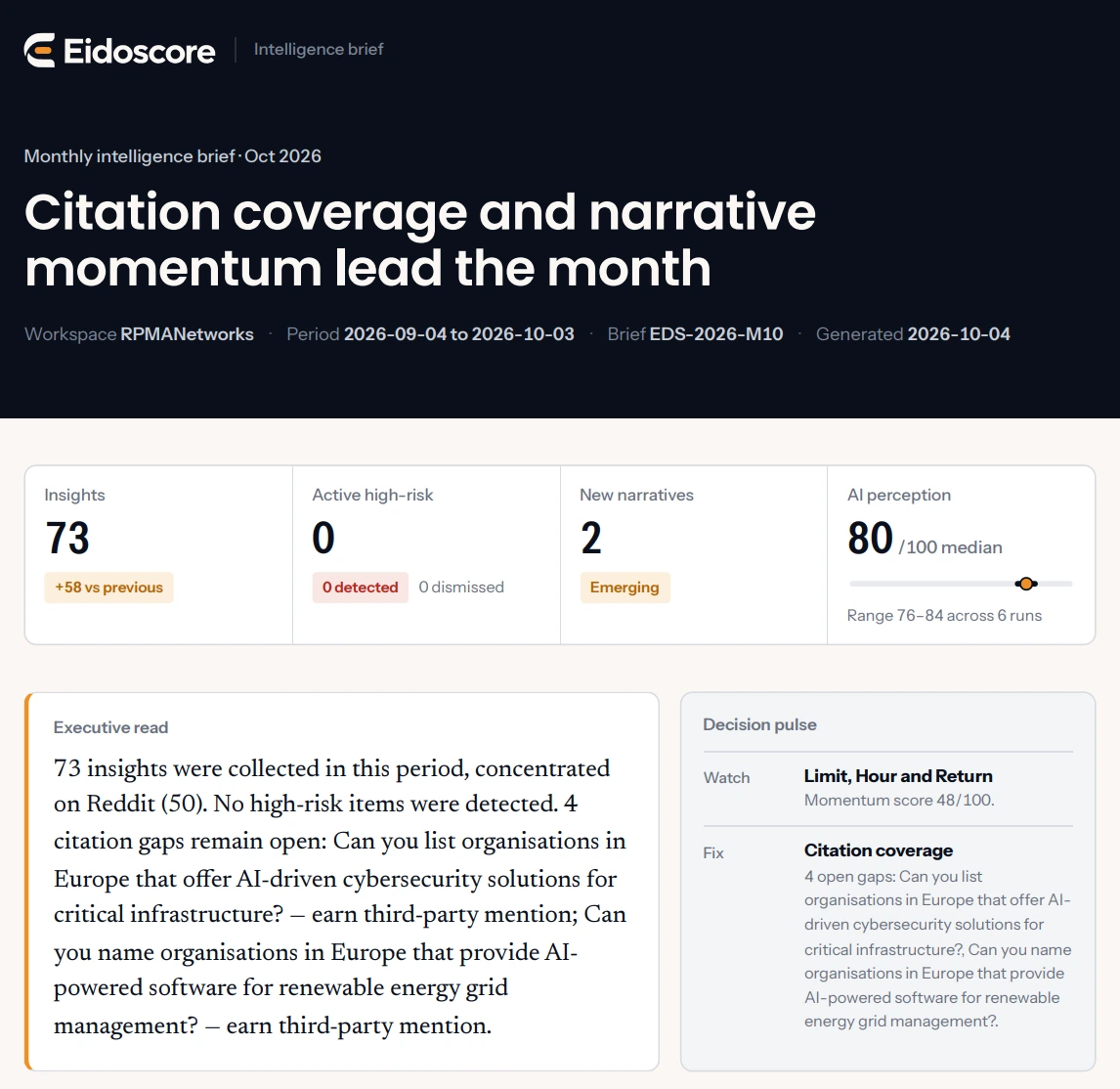
EU-hosted, public sources only
Public Telegram channels and Reddit communities. Never private groups.
Topics and narratives, not individuals
Flags are early warnings held for a reviewer, never automated accusations.
A named person approves every action
Nothing is published or sent on its own, and the audit log cannot be edited.
See this on your own narratives.
A working session on your questions and channels, with real answers and sources. Nothing is sent without your approval.