
How Eidoscore works: monitor, understand, assess, act.
Eidoscore collects AI answers and public conversation, groups them into narratives with evidence, scores what is at stake and drafts the response for a named person to approve.
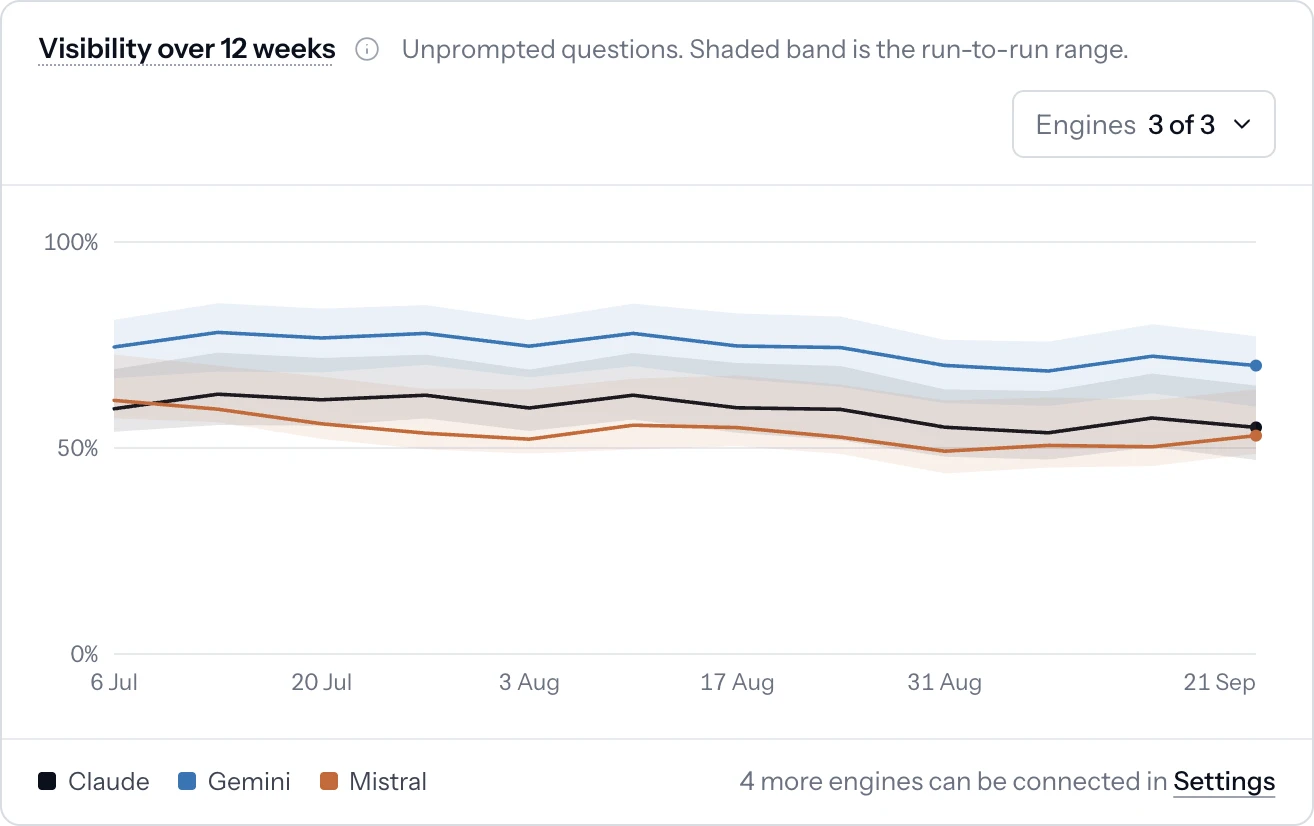
Underneath sits one rule. Language models give different answers to the same question, so every figure is reported as a range across scheduled runs, and every raw answer is kept.
Four stages, from public signal to approved action.
Each stage feeds the next. A visibility figure moves, the narrative behind it is already grouped, its sources are listed, and a response is drafted for approval.
Collect what the engines say and what the public says.
Your tracked questions go to each selected engine (ChatGPT, Claude, Gemini and Mistral) once on every scheduled run. Public Telegram channels and Reddit communities are collected alongside, and collection health is visible, so you know when a source needs attention.
- One answer per question per engine on every scheduled run, with engine and model version recorded
- Public channels and communities only, never private groups
- Web and news pages appear as the domains the engines cite
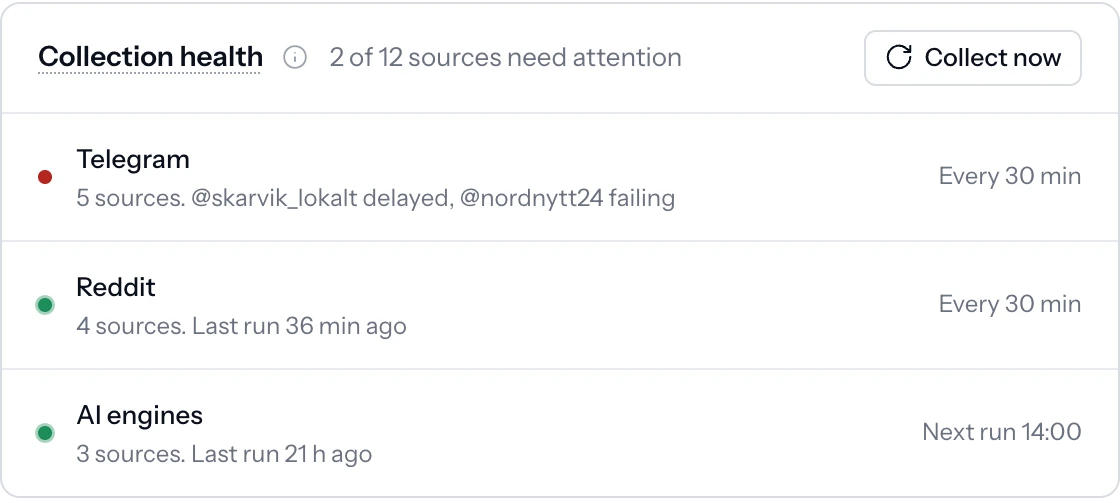
Turn a list of posts into a story you can follow.
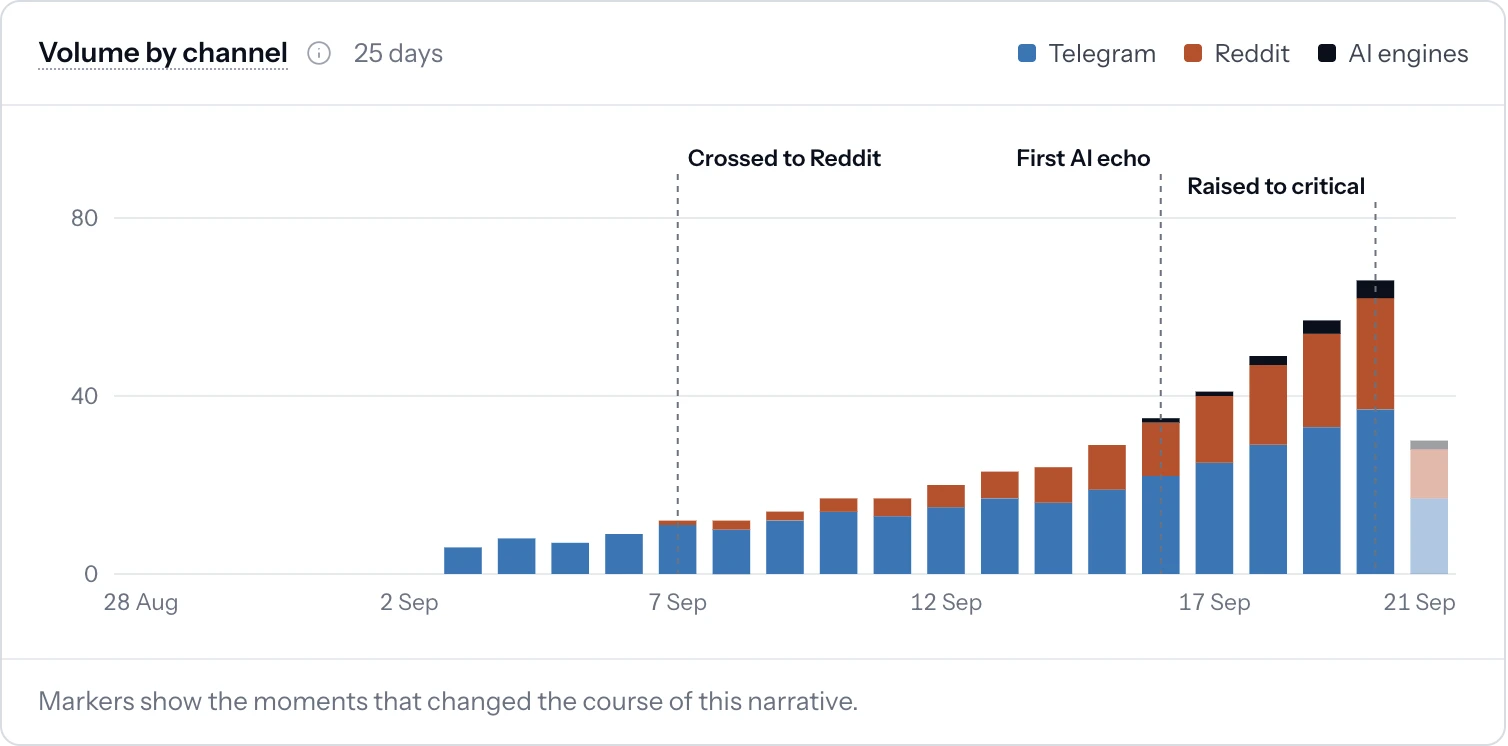
Each item is classified for stance and kept in its original language with a translation. Related items are grouped into narratives with severity, momentum and a spread timeline, so you see where a story started and how fast it is moving.
- Stance: hostile, questioning, neutral or supportive
- Severity from Info to Critical, momentum from emerging to fading
- Every narrative links to the posts and AI answers as written
Score what is at stake. A person decides.
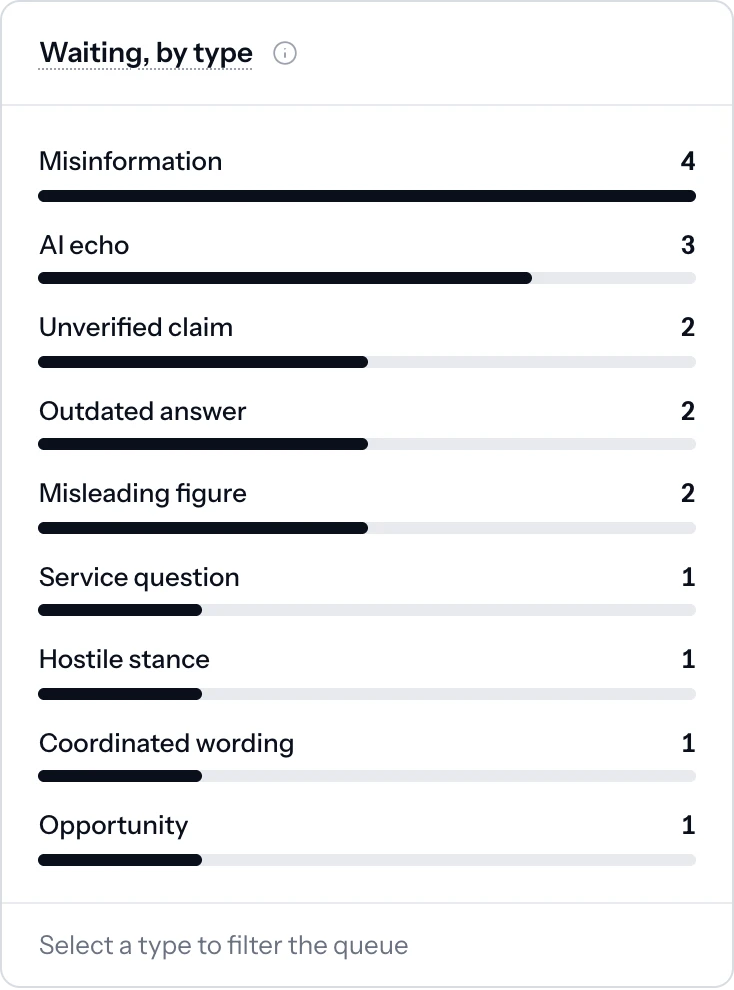
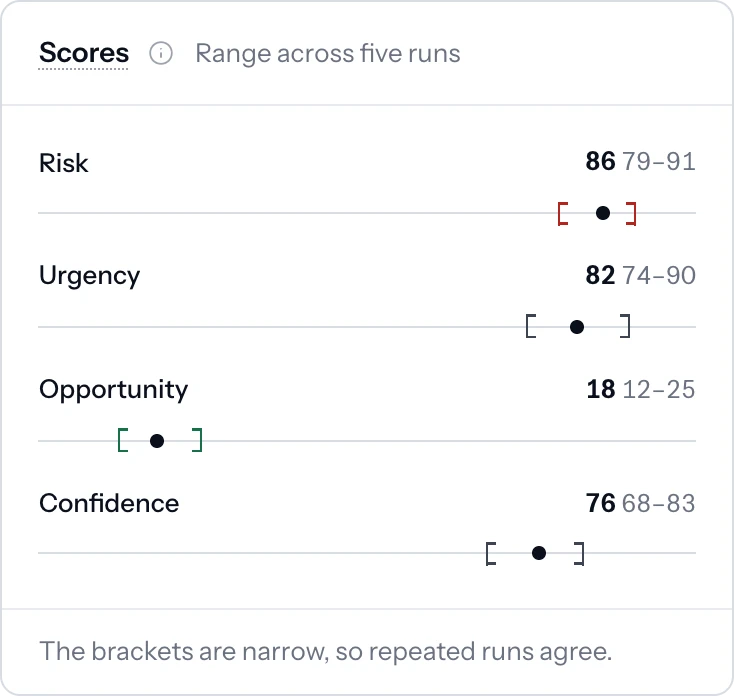
Risk, Urgency, Opportunity and Confidence rank what needs attention. Claims that look false, misleading, unverified or outdated are flagged as early warnings with their evidence. A reviewer reads the original, the translation and the scores, then approves or dismisses.
- Risk, Urgency, Opportunity and Confidence on every item
- Flags are early warnings, never accusations
- No claims of coordinated campaigns
Draft the response. A named person approves it.
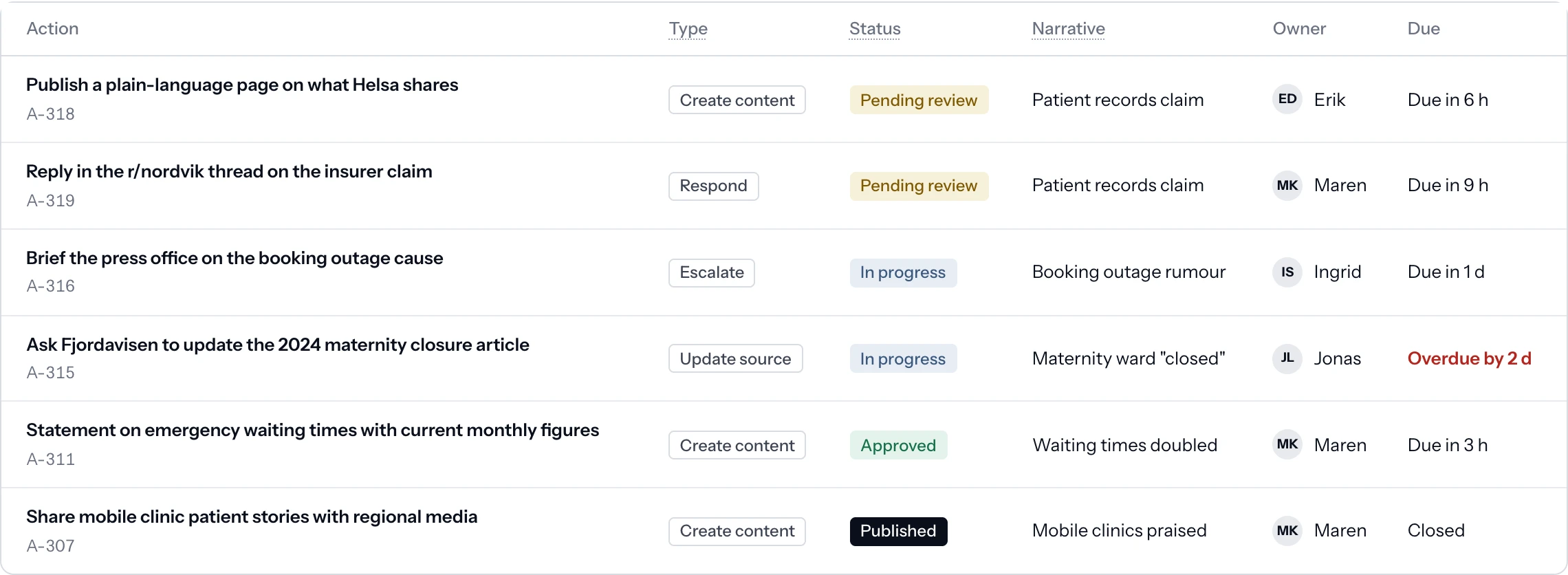
Every recommended action arrives as a draft with its reasoning. Your team edits, approves or declines it in the action centre, and the decision is written to an audit log that cannot be edited or deleted. A fixed brief reaches leadership every Monday.
- Content, corrections and source updates drafted with their reasoning
- Approval by a named person before anything is published or sent
- Weekly and monthly briefs, fixed once generated
Scheduled runs, honest ranges
Each tracked question is asked once per engine on every scheduled run. We report the median and the range across runs, not a single score, and every point links to the stored answer. If the runs disagree, you see that they disagree.
The same rule everywhere a number appears. The bracket is the lowest and highest result across the runs, the point is the median. A narrow bracket means the engines agree with themselves. A wide one means treat the figure with care.
What we record for every run
Six things, stored with every answer, so a figure in a brief can be traced to the exact answer behind it.
Engine and model version
Which engine answered, and which version of it.
Prompt and prompt version
The exact wording that was asked, versioned.
Date and time
When the answer was captured, and how.
The full answer
Stored as written, never summarised away.
Every citation
Each source the engine gave, by domain.
Who appeared, and how
Whether you, a competitor or the tracked narrative was named.
Where the answers come from
Labelled at capture
Engine, model version, prompt version, time and collection method travel with every data point, so any figure in a brief traces back to the exact answer behind it.
Variation is stated, not smoothed
Answers differ between runs, model versions, the API and the consumer app, and can differ by region and language. We treat that as a measurement to report.
A figure describes recorded conditions
An Eidoscore figure is what the engines returned to our prompts, under recorded conditions, over a recorded period. It is never a claim about what one person saw on one day.
How classification works
Misinformation flags are early warnings for a human reviewer, never automated accusations, and never claims of coordinated campaigns.
Topic, language and stance
A language model labels each item hostile, questioning, neutral or supportive, and keeps the original text with a translation.
A risk type where one applies
Misinformation, an AI echo of a claim, an unverified claim, an outdated answer, a misleading figure or an opportunity.
Confidence and correction
Every insight carries a confidence score and a manual correction field. Quality is measured against a hand-labelled evaluation set.
What we will not do
- No monitoring of private or closed groups.
- No profiling of identifiable individuals by political opinion. We monitor topics, narratives and communities.
- No auto-publishing. Nothing leaves the workspace without a named person approving it.
- No claims we cannot evidence. Every alert links to its sources, model version and prompt version.
See the method on your own narratives.
A working session on your own questions and channels, with real answers, sources and the range behind every figure. Nothing sent without your approval.