
What moved, why it matters, and what to do.
Leadership does not need another dashboard. It needs a ten-minute brief: what assistants say about the organisation, which narratives grew or faded this week, where the risks and openings are, and a recommended action for each, with every claim linked to its evidence.
Three questions, every week.
Leadership teams do not lack data. They lack a reliable weekly answer to three questions: what changed, does it matter, and does anything need a decision from us. Dashboards present activity and leave the interpretation to whoever has time, which means it happens late or not at all.
The answer also has to survive scrutiny. When a board or a regulator asks why a response went out, it has to be a documented decision with a named approver behind it, not a recollection.
The first time leadership hears about a narrative is when a journalist calls about it, and the meeting becomes about why nobody knew rather than what to do.
A plain-language read, and the figures behind it.
Two screens from the workspace, with the evidence one click away. Every figure is a range across scheduled runs, and every narrative links to the posts and answers behind it.
A brief written for people who will never open the platform.
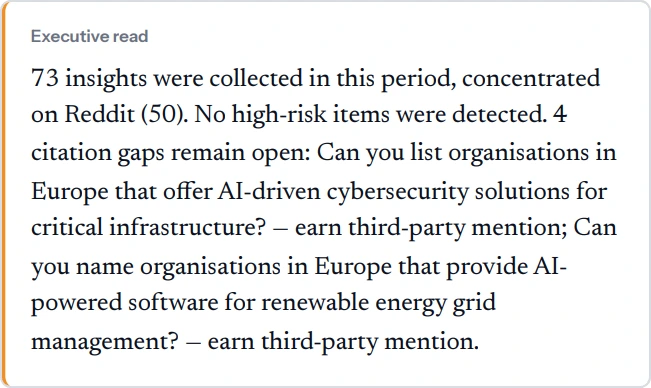
Each brief opens with an executive read in plain language: what was collected, what was detected and which citation gaps remain open. It is fixed once generated and exported as PDF or DOCX, so the version the board read is the version on record.
- Plain language first, figures second
- Every claim linked to the posts and answers behind it
- Weekly on Monday at 06:00, plus a monthly brief
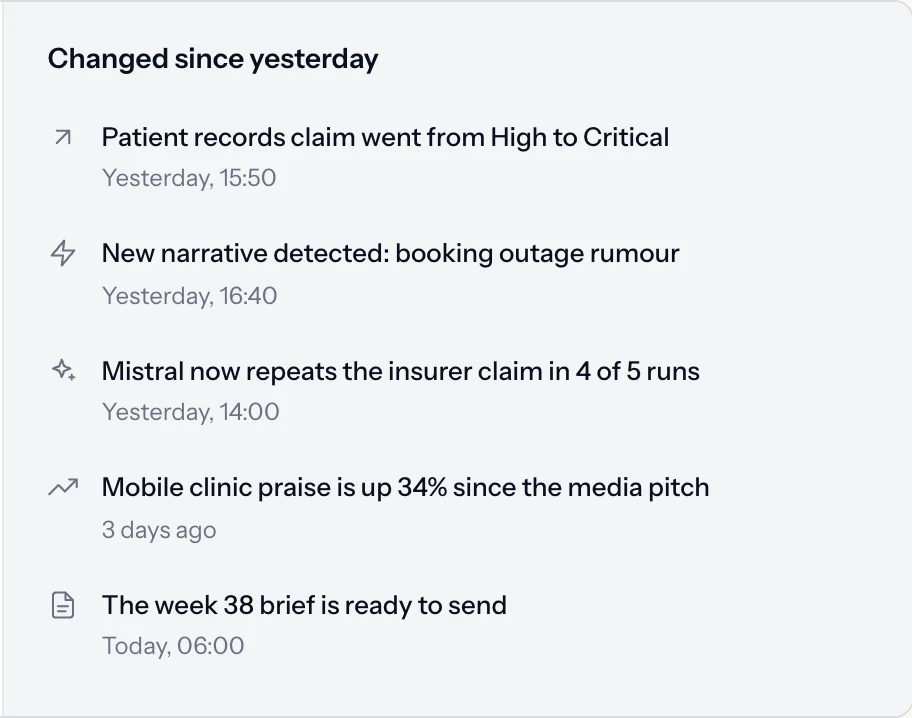
What moved since yesterday, in a few lines.
The command centre lists what changed: a claim raised from High to Critical, a new narrative detected, an engine now repeating a claim in most runs, praise up a third, the weekly brief ready to send. Measured the same way every day, so the meeting argues about the decision rather than the numbers.
- Severity changes, new narratives and engine echoes, each with the figure behind it
- AI visibility as a median with its range, never a single score
- The brief flagged when it is ready, so nothing waits on someone remembering
What we monitor for you.
The topics, sources and question sets we set up for teams like yours.
Weekly movement
Which narratives grew, faded or emerged since the last brief, with the reason attached rather than just the direction.
Decision queue
The small number of items that genuinely need a leadership decision this week, separated from everything that does not.
Risk and opportunity
Scored consistently week to week, so the meeting argues about the decision rather than about the numbers.
Audit trail
Every alert, draft, approval and rejection recorded with a named person and a timestamp, ready for board or compliance review.
Three jobs it does for leadership and communications.
Each one ends in something a named person can review, approve and send.
- 01
A weekly intelligence brief with ranges, evidence and recommended actions
- 02
Risk and opportunity scoring, so the team argues about decisions, not data
- 03
An audit trail behind every alert and approval, ready for board and compliance questions
Questions we hear from leadership and communications.
Something else?
The full list covers sources, method, security and commercial terms.
Ten minutes a week for the brief. Everything deeper is optional.
Evidence-linked and exported as PDF or DOCX, written to be read by people who do not use the platform.
The brief says so. No manufactured urgency.
What the brief contains.
A weekly brief every Monday at 06:00 and a monthly brief, both fixed once generated and exported as PDF or DOCX.
- An executive read: what happened, in plain language
- AI perception as a median with its range across scheduled runs
- Open citation gaps, each with its recommended action
Flags are reviewed by an Eidoscore analyst before the brief is generated. Approval stays with you.
Reports in the product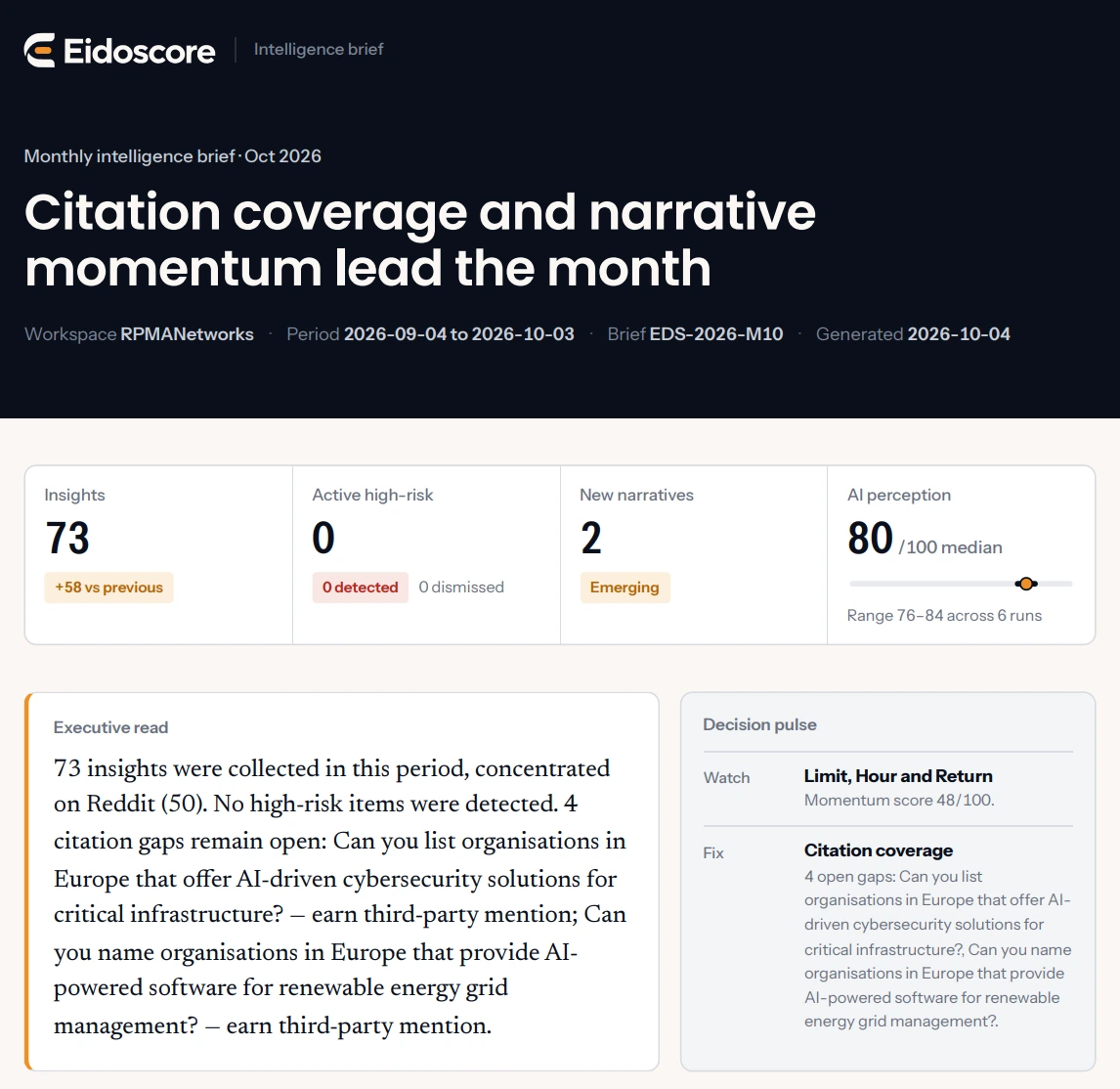
EU-hosted, public sources only
Public Telegram channels and Reddit communities. Never private groups.
Topics and narratives, not individuals
Flags are early warnings held for a reviewer, never automated accusations.
A named person approves every action
Nothing is published or sent on its own, and the audit log cannot be edited.
See this on your own narratives.
A working session on your questions and channels, with real answers and sources. Nothing is sent without your approval.