
How is your policy debate framed in AI answers?
Public affairs runs on framing, not mention counts. Eidoscore tracks how a file and your position are represented in AI answers and public channels, clusters the narratives, and routes recommended actions through your review.
For public affairs teams, AI visibility intelligence shows how AI assistants frame a policy debate and your position within it, which sources and communities shape that framing, and where the debate is moving. Eidoscore turns this into a weekly brief with evidence, so leadership sees what changed and what needs a decision.
Framing wins files. Counts cannot show it.
Whether a file is described as a safeguard or a burden matters more than how often it is mentioned, and a mention count cannot tell you which description is winning. The vocabulary that takes hold while a consultation is open tends to survive into the final text.
Officials and journalists researching a file now get their orientation from an assistant. If that summary omits your position, or attributes it to someone else, the omission travels into briefing notes and committee questions.
A policy summary that omits your position gets copied into a briefing note, then into a committee question, then into the record. The correction always arrives after the vote.
What each engine says, and where it gets it.
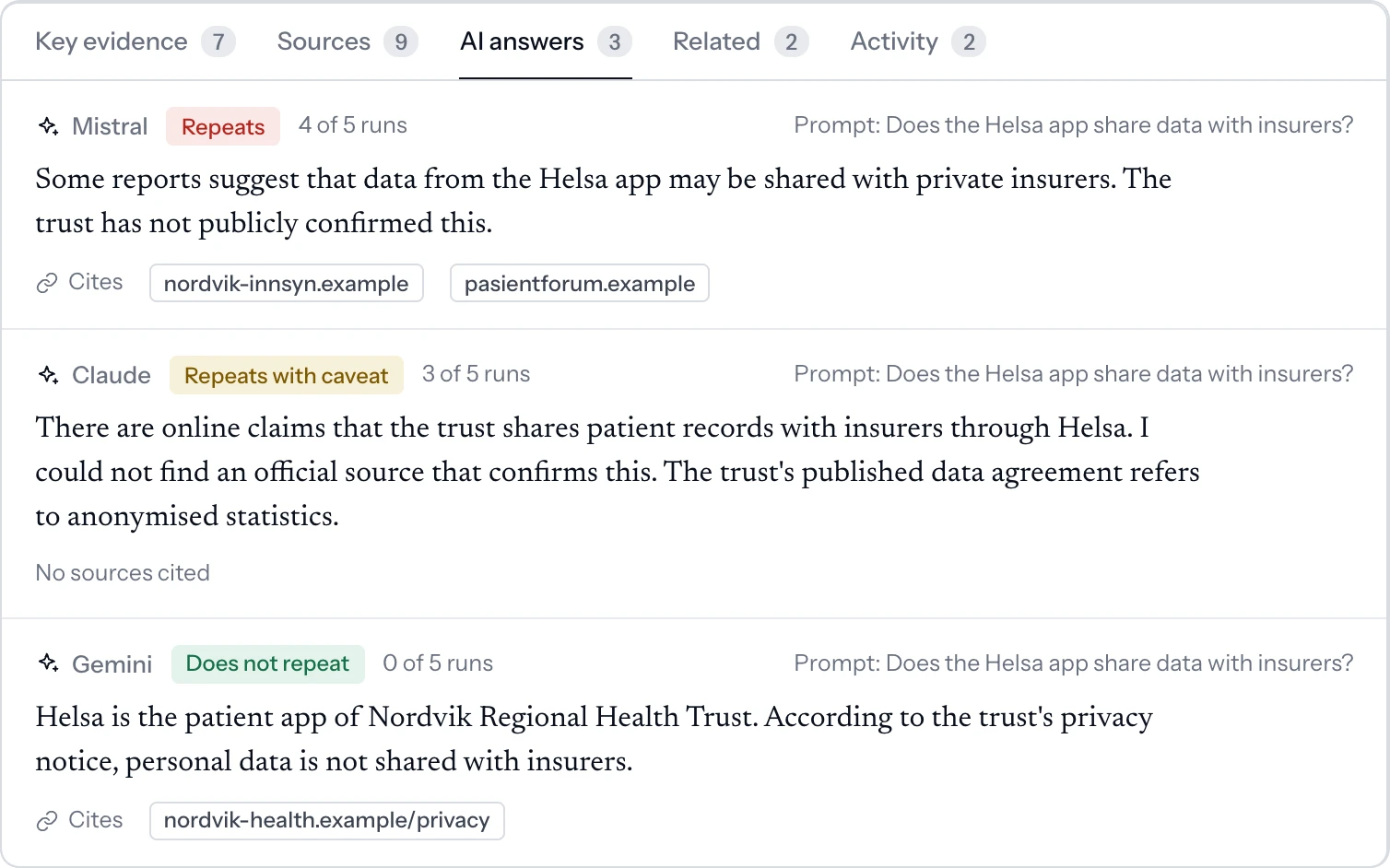
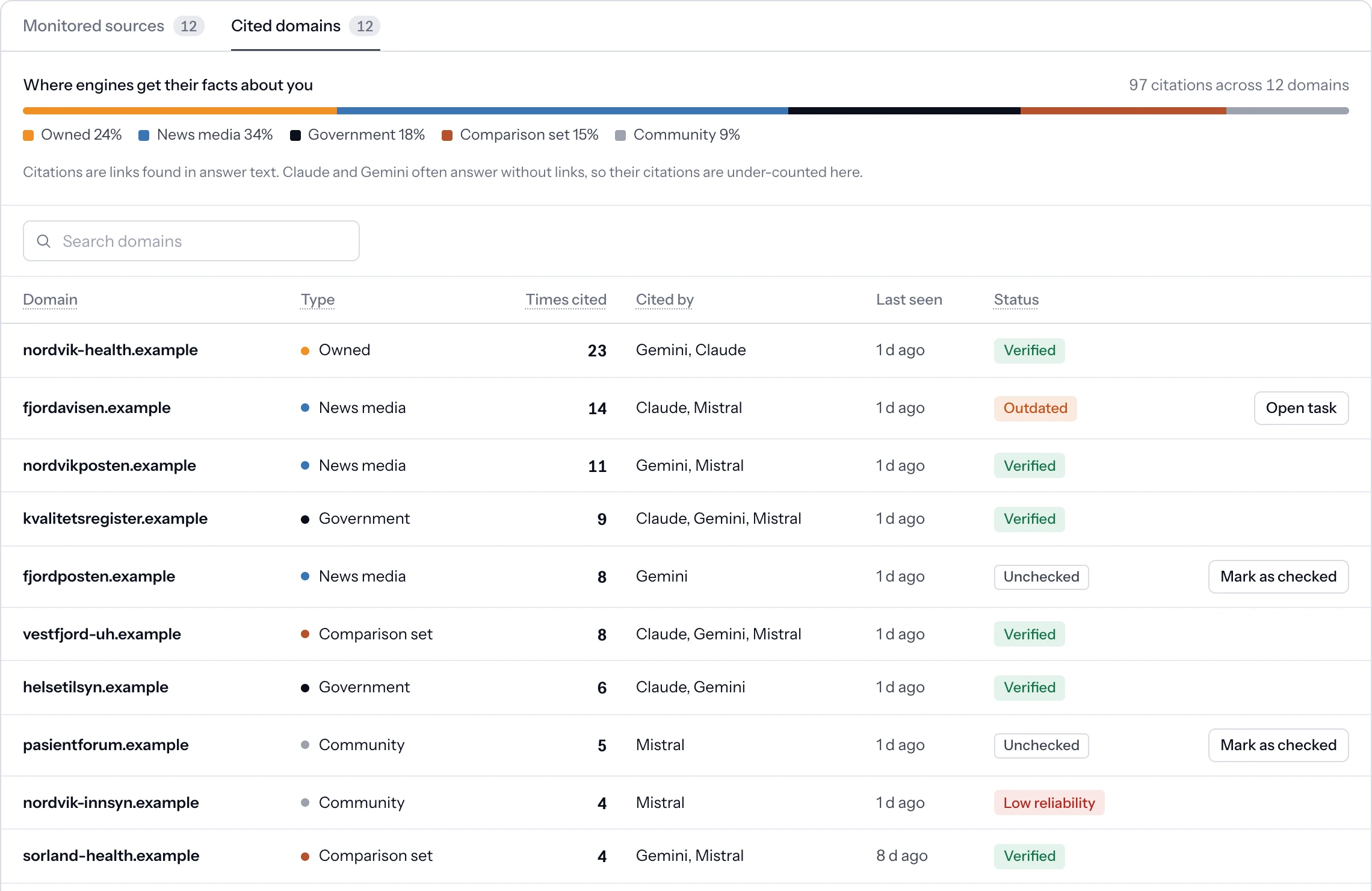
Two screens from the workspace, with the evidence one click away. Every figure is a range across scheduled runs, and every narrative links to the posts and answers behind it.
Read what each engine says about the file, run by run.
For every tracked question you see what ChatGPT, Claude, Gemini and Mistral answered, how many runs repeated a given claim, and which sources each run cited. Engine, model version and prompt version are recorded, so a finding can go into a briefing note with its provenance attached.
- The answer as written, per engine and per run
- How many runs repeated a claim, so a one-off is not reported as a trend
- The citations behind each answer, ready for a note
See which sources carry weight on your topics.
Cited domains shows where the engines get their facts on your questions: each domain by type, how many times it was cited, which engines cited it and its status. It tells you whether the debate is being summarised from government pages, news media or community forums, and where your own material is missing.
- Domains by type: owned, news media, government, comparison set, community
- Times cited, cited by which engine, and a status such as verified or outdated
- An outdated article becomes a task, routed through your approval
What we monitor for you.
The topics, sources and question sets we set up for teams like yours.
File-level framing
How a specific piece of legislation or consultation is characterised, tracked week to week so you can see the vocabulary shift as it happens.
Actor comparison
Relative visibility and framing strength across a defined set of stakeholders on the same policy questions.
Coalition signals
Where support and opposition are forming in public discussion, and which arguments are gaining and losing traction.
Evidence trails
Every claim linked to its source as written, so anything in the brief can move straight into an internal briefing note.
Three jobs it does for public affairs.
Each one ends in something a named person can review, approve and send.
- 01
Policy-position representation across each monitored assistant, tracked over time
- 02
Narrative clusters across public Telegram and Reddit sources, scored for risk and urgency
- 03
A weekly brief your leadership can act on, every claim linked to evidence
Questions we hear from public affairs.
Something else?
The full list covers sources, method, security and commercial terms.
Yes. Workspaces are topic-led: an issue, a file, a piece of legislation or an organisation.
Yes. Define a comparison set and the brief reports relative visibility, framing and citation strength.
Every claim links back to its source as written, so evidence can go straight into a briefing note.
What the brief contains.
A weekly brief every Monday at 06:00 and a monthly brief, both fixed once generated and exported as PDF or DOCX.
- An executive read: what happened, in plain language
- AI perception as a median with its range across scheduled runs
- Open citation gaps, each with its recommended action
Flags are reviewed by an Eidoscore analyst before the brief is generated. Approval stays with you.
Reports in the product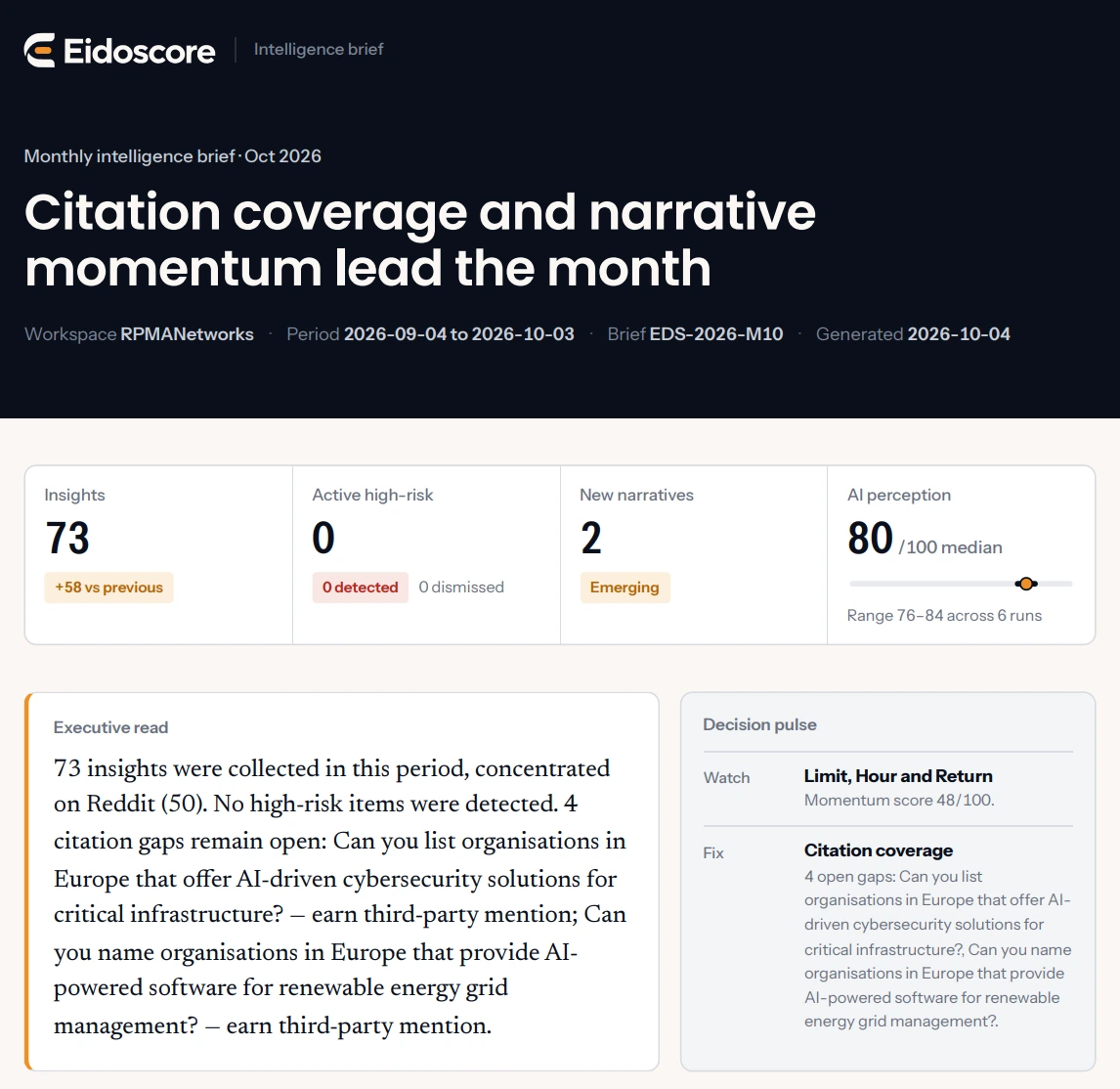
EU-hosted, public sources only
Public Telegram channels and Reddit communities. Never private groups.
Topics and narratives, not individuals
Flags are early warnings held for a reviewer, never automated accusations.
A named person approves every action
Nothing is published or sent on its own, and the audit log cannot be edited.
See this on your own narratives.
A working session on your questions and channels, with real answers and sources. Nothing is sent without your approval.