
What does AI tell voters about you?
Voters ask an assistant before they ask a canvasser, and the framing they get was often set days earlier in public Telegram channels. Eidoscore watches both, flags what is moving, and gives your team a reviewed brief it can act on.
A campaign is a deadline.
Perception hardens in the final weeks. By the time a framing reaches your press monitoring it has usually circulated in public channels for days, and the gap between a claim starting to move and your team hearing about it is the whole problem.
The assistant's answer is assembled from a narrow set of sources, mostly news archives and reference entries. If your record is summarised from three-year-old coverage, that is the version being read at the doorstep.
A single claim, unanswered for ten days, becomes the sentence an assistant uses to describe your candidate, and the one voters repeat back to your canvassers in the final week.
The story forming, and the answer voters get.
Two screens from the workspace, with the evidence one click away. Every figure is a range across scheduled runs, and every narrative links to the posts and answers behind it.
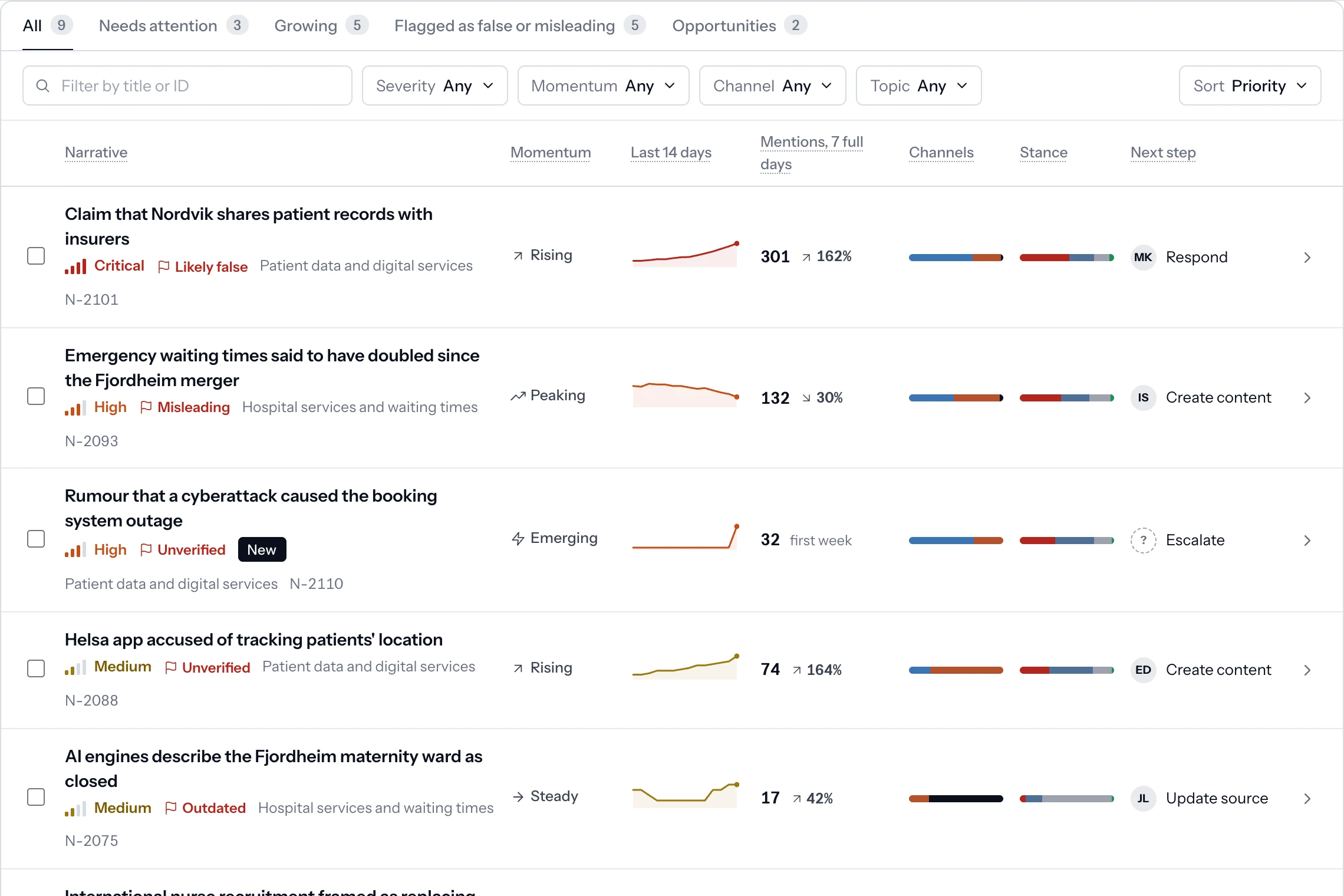
See a hostile framing while it is still a few threads.
Mentions from public Telegram channels and Reddit communities are grouped into narratives, each with a severity from Info to Critical, a momentum and flags such as likely false or misleading. You see the story forming, with every post behind it shown as written and translated.
- Severity, momentum and a 14-day trend on one row
- Flags for likely false, misleading, unverified or outdated claims
- A recommended next step on each narrative, held for your approval
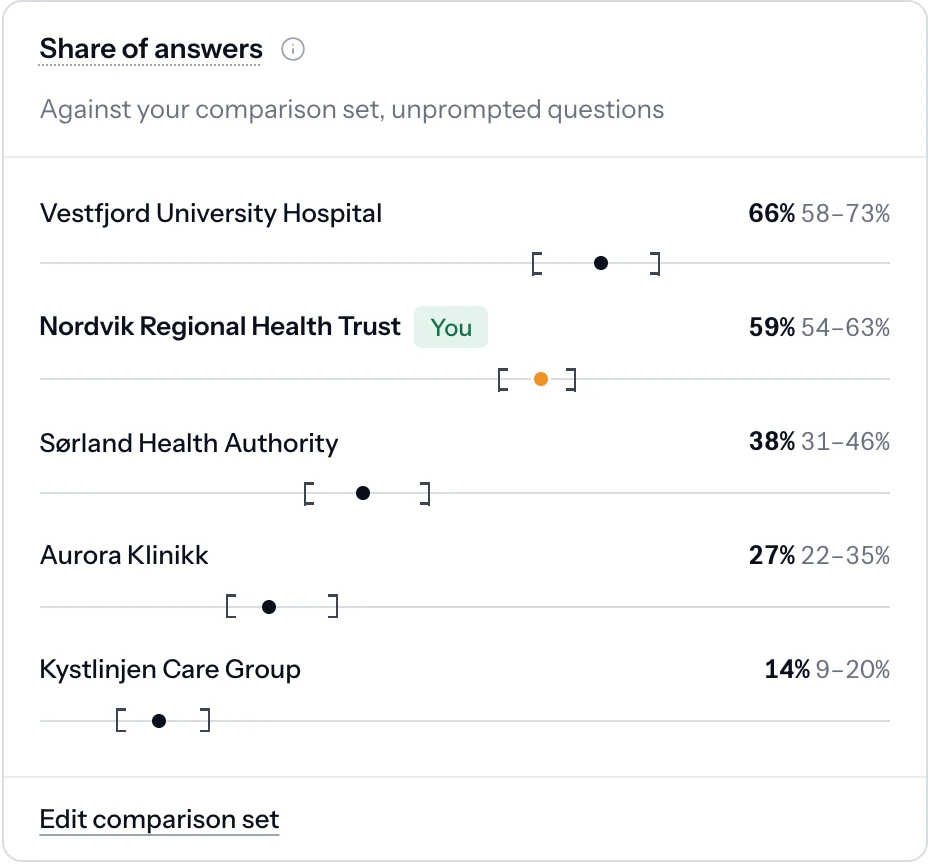
Know how often assistants name you against your opponents.
The questions voters put to ChatGPT, Claude, Gemini and Mistral are asked once per engine on every scheduled run. You see your share of answers against a comparison set of opposing actors, your position when named, and the range behind every figure, so nobody is arguing over a single screenshot.
- Share of answers against the actors you choose to compare with
- Bracket and median across scheduled runs, not one snapshot
- Every answer and citation stored with engine and model version
What we monitor for you.
The topics, sources and question sets we set up for teams like yours.
Position representation
How each assistant summarises your positions and your record, tracked over scheduled runs so you see drift rather than a snapshot.
Hostile framing
Phrases and claims about your candidate or party gaining traction in public channels, clustered into narratives and scored for spread.
Comparative visibility
How you appear against a defined set of opposing actors on the same questions, with the evidence behind each answer.
Source strength
Which sources assistants rely on when asked about you, which are outdated, and which gaps are worth closing before they matter.
Three jobs it does for political organisations.
Each one ends in something a named person can review, approve and send.
- 01
Track how assistants describe your positions and your opponents, with ranges and evidence
- 02
Early warning when a hostile framing or false claim starts moving in public channels
- 03
Citation gaps: which sources AI relies on about your topics, and which are missing or outdated
Questions we hear from political organisations.
Something else?
The full list covers sources, method, security and commercial terms.
You can track how assistants describe opposing campaigns and how their narratives develop in public channels. We monitor topics and narratives, not private individuals.
Yes. The Campaign War Room adds daily alerts and response drafts for a defined period, with a direct channel to your analyst.
Public sources only, EU hosting, and a Data Protection Impact Assessment before any scaled monitoring of political content.
What the brief contains.
A weekly brief every Monday at 06:00 and a monthly brief, both fixed once generated and exported as PDF or DOCX.
- An executive read: what happened, in plain language
- AI perception as a median with its range across scheduled runs
- Open citation gaps, each with its recommended action
Flags are reviewed by an Eidoscore analyst before the brief is generated. Approval stays with you.
Reports in the product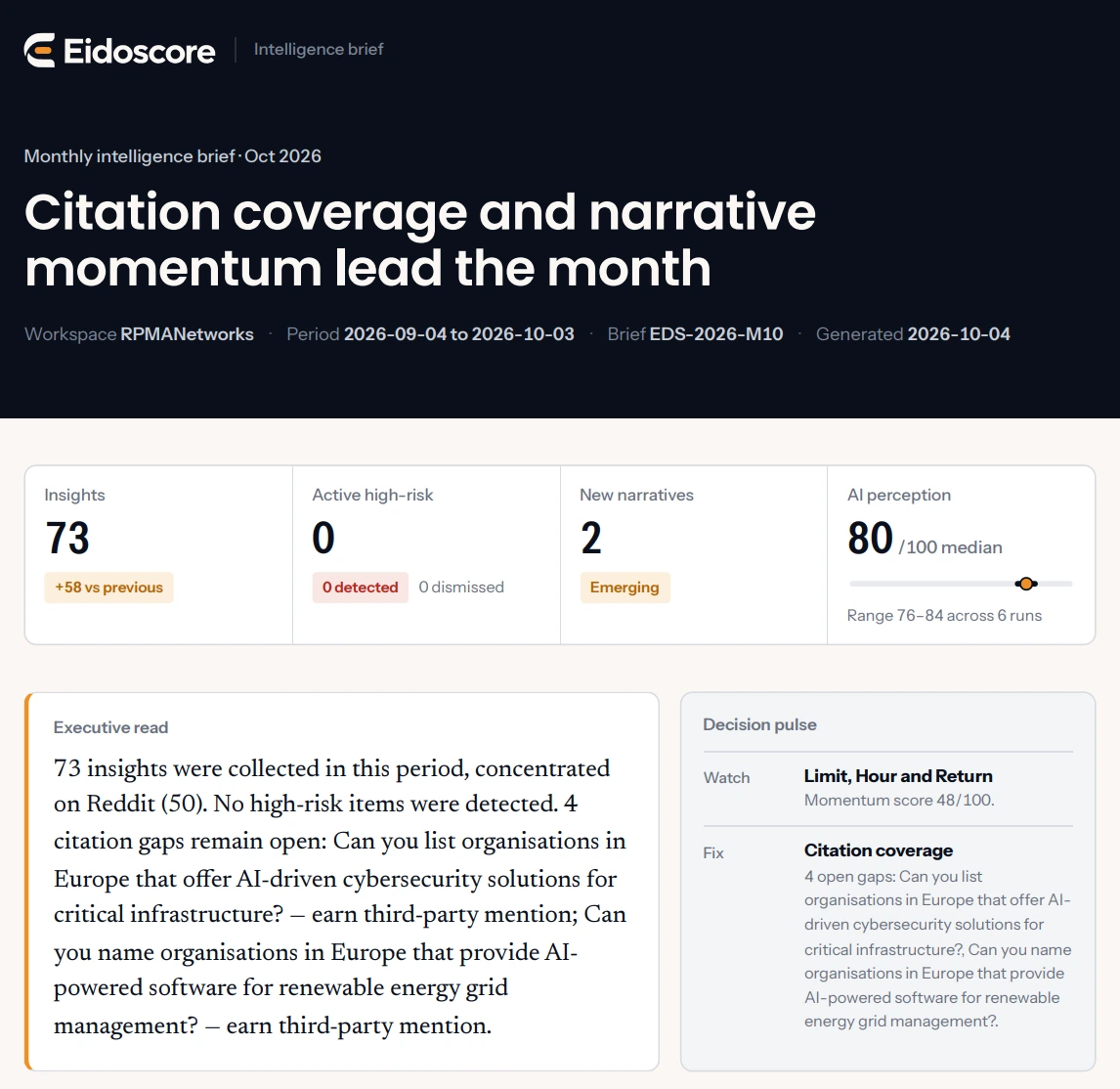
EU-hosted, public sources only
Public Telegram channels and Reddit communities. Never private groups.
Topics and narratives, not individuals
Flags are early warnings held for a reviewer, never automated accusations.
A named person approves every action
Nothing is published or sent on its own, and the audit log cannot be edited.
See this on your own narratives.
A working session on your questions and channels, with real answers and sources. Nothing is sent without your approval.